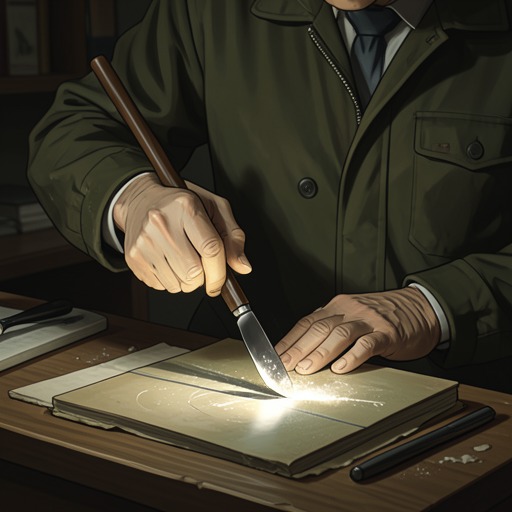
The distinction between cutting and chopping
The Book of Five RingsThe rule distinguishes a decisive cut from a slash that only touches the opponent, even if that contact is forceful or immediately fatal. It makes the difference one of intention and spirit, not simply the visible result: a sword action counts as a cut when it is carried through with resolve. This distinction gives the practical instruction of the Water Book a wider strategic measure—victory depends on understanding what an action accomplishes, not merely how it appears.
The Rule in Practice
The text first separates the two actions sharply. Cutting, in whatever form, is decisive; slashing is no more than touching the enemy. Strength alone does not settle the matter: an opponent may die instantly from a strong slash, yet the action remains a slash in the terms of the rule. The decisive criterion is the spirit with which the action is made.
The distinction also governs follow-up. If a fighter first slashes the opponent’s hands or legs, that contact is not treated as the completed act of cutting; the instruction is to cut strongly afterward. The rule therefore describes a sequence as well as a contrast: preliminary contact may reach or injure the opponent, but it does not substitute for a resolved finishing action.
Contact, Resolve, and Technique
The passage complicates its initial opposition by saying that slashing is, in spirit, the same as touching. Once this is understood, cutting and slashing become indistinguishable. That qualification does not erase the practical distinction; it locates the distinction in the fighter’s intent rather than in a fixed inventory of motions. The same contact can be understood differently according to whether it is merely a touch or part of a decisive cut.
This emphasis on intent belongs to a broader account of embodied sword technique. The fighter is told to grip the Long sword with the hands ready for cutting, to avoid a fixed or dead hand, and to preserve pliability even while maintaining the intention to cut. Footwork, posture, and the broad gaze are likewise trained so that everyday bodily habits become usable in combat. The cut-and-slash rule thus connects a mental standard to the practiced coordination of perception and movement.
Strategy Beyond the Single Stroke
The book presents strategy as the craft of overcoming opponents, from individual contests to battles involving large numbers. Its five-book structure places the sword’s practical principles within a larger Way: the Ground book establishes the outline, while the Water Book explains the principles of the Ichi school through the image of water, which changes shape while retaining its character. In that framework, distinguishing a decisive cut from mere contact is a small but consequential lesson in judging action by its strategic purpose.
The same emphasis on judgment appears in the instruction to know the enemy’s disposition, strengths, and weaknesses, and to act from an advantageous position. A fighter who mistakes contact for completion has confused a visible movement with its intended result. The rule insists instead on a clear standard: a cut must be carried through decisively, while a slash remains only a touch unless the fighter understands and completes the action as a cut.
A Practical and Editorial Principle
The distinction also reflects the book’s criticism of narrow technical specialization. It rejects the idea that small movements and dexterity alone constitute mastery, especially when they fail to answer the conditions of real combat. Training is meant to prepare a fighter to prevail in life-or-death encounters, and the text extends the principle from an individual contest toward the possibility of one man defeating many and large forces defeating still larger ones.
In the Wind Book, the author surveys other schools but declines to name them or reduce their doctrines to fixed lists, noting that branches interpret teachings differently and that no single person’s conception can stand for every school. Against that tendency to prize particular forms, the cut-and-slash rule offers a compact test of substance: the important question is not whether a motion looks forceful or belongs to a prescribed technique, but whether it expresses and completes the decisive action required to defeat the opponent.